LYME BORRELIOSIS: Clinical Disease In Animals
Clinical Disease in Animals:
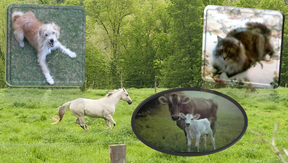
Dogs, cats, horses and cattle appear to be the only animals (apart from humans) that may develop a clinical illness due to the Borrelia species responsible for Lyme disease. |
Clinical Disease and Contact Transmission of Lyme Borreliosis in Animals
In addition to humans, the only animals that may develop a clinical illness due to a Borrelia infection appear to be dogs, cats, horses and cattle (25).
The primary symptom in all these animals is arthritic in nature, where inflammation of joints and limbs may lead to lameness
Dogs are competent reservoir hosts (26) and seem to be the most susceptible to developing a clinical illness (25, 27). As they are generally in close contact with humans, rates of Borrelia infection/exposure in dogs has also been studied in order to try and ascertain what the degree of risk of Borrelia exposure to humans may be within particular areas/environments (28-30). Apart from lameness (shifting leg lameness in particular), other symptoms in dogs may include; anorexia/weight loss, malaise, neurological dysfunction (25), severe polyarthritis (27), renal lesions (31,32), splenomegaly/ lymphadenopathy, intraocular inflammation (33) abnormal gait and convulsions (34).
Cats are more prone to asymptomatic infections (33), though as well as lameness they may develop; fever, anorexia, fatigue (35-36), and kidney problems (37).
Asymptomatic infections seem to be the most common in horses and cattle (38-41), although clinical illness can develop with symptoms in both animals including lameness, uveitis and weight loss (38, 41-43). Other signs in cattle include decreased milk production and abortion (42, 44,45), with head tilt, encephalitis (46,47), aborted, reabsorbed foetuses and foal mortality also being reported in clinical disease in horses (48,49).
Contact Transmission in Animals
Borrelia spirochetes have been found in the urine of infected dogs (31, 50) horses (45, 51) and cattle (45), in both symptomatic and asymptomatic animals. Studies on mice found that the spirochetes in urine remained viable for 18-24 hours and concluded that “Urine may provide a method for contact non-tick transmission of B. burgdorferi in natural rodent populations particularly during periods of nesting and/or breeding” (52: pg 40). Evidence for direct contact transmission has been demonstrated in mice (53) and further studies are required in larger animals to ascertain the potential for the Borrelia spirochete to be transmitted simply by being in close contact with an infected animal.
The short segment above has been reproduced from the "Role of Mammals as Vector and Reservoir Hosts of Lyme" section for ease of access for those looking for information with regards to Lyme disease in animals.
References: LYME BORRELIOSIS: Clinical Disease In Animals
Relevant References from the Reference Section of : Role of Mammals as Vector and Reservoir Hosts
(25) Skotarczak B (2002) Canine borreliosis--epidemiology and diagnostics. Ann Agric Environ Med; 9(2):137-40. http://www.ncbi.nlm.nih.gov/pubmed/12498579
(26) Mather TN, Fish D and Coughlin RT (1994) Competence of dogs as reservoirs for Lyme disease spirochetes (Borrelia burgdorferi). J Am Vet Med Assoc; 205(2):186–188. http://www.ncbi.nlm.nih.gov/pubmed/7928571
(27) Krupka I and Straubinger RK (2010) Lyme borreliosis in dogs and cats: background, diagnosis, treatment and prevention of infections with Borrelia burgdorferi sensu stricto. Vet Clin North Am Small Anim Pract; 40(6):1103-19. http://www.ncbi.nlm.nih.gov/pubmed/20933139
(28) Lindenmayer M, Marshall D and Onderdonk AB (1991) Dogs as sentinels for Lyme disease in Massachusetts. Am J Public Health; 81(11): 1448–1455. http://www.ncbi.nlm.nih.gov/pmc/articles/PMC1405676/
(29) Artsob H, Barker IK, Fister R, Sephton G, Dick D, Lynch JA and Key D (1993) Serological studies on the infection of dogs in Ontario with Borrelia burgdorferi, the etiological agent of Lyme disease. Can Vet J; 34(9): 543–548. http://www.ncbi.nlm.nih.gov/pmc/articles/PMC1686584/
(30) Hansen K and Dietz HH (1989) Serosurvey for antibodies to Borrelia burgdofferi in Danish dogs. Acta Pathol Microbiol Immunol Scand; 97(3):281-285. http://www.ncbi.nlm.nih.gov/pubmed/2713138
(31) Grauer GF, Burgess FC, Cooley AJ and Hagee JH (1998) Renal lesions associated with Borrelia burgdorferi infection in
a dog. J Am Vet Med Assoc; 193 (2) 237-239. http://www.ncbi.nlm.nih.gov/pubmed/3403355
(32) Dambach DM, Smith CA, Lewis RM and Van Winkle TJ (1997) Morphologic, immunohistochemical, and ultrastructural characterization of a distinctive renal lesion in dogs putatively associated with Borrelia burgdorferi infection: 49 cases (1987-1992). Vet Pathol; 34(2):85-96. http://www.ncbi.nlm.nih.gov/pubmed/9066075
(33) Shaw SE, Binns SH, Birtles RJ, Day MJ, Smithson R and Kenny MJ (2005) Molecular evidence of tick-transmitted infections in dogs and cats in the United Kingdom. Vet Rec;157(21):645-8. http://www.ncbi.nlm.nih.gov/pubmed/16299364
(34) Azuma Y, Isogai E, Isogai H and Kawamura K (1994) Canine Lyme disease: clinical and serological evaluations in 21 dogs in Japan. Vet Rec; 134(15):369-72. http://www.ncbi.nlm.nih.gov/pubmed/8009799
(35) Magnarelli LA, Anderson JF, Levine HR and Levy SA (1990) Tick parasitism and antibodies to Borrelia burgdorferi in cats. J Am Vet Med Assoc; 197(1):63-6. http://www.ncbi.nlm.nih.gov/pubmed/2196252
(36) Magnarelli LA, Bushmich SL, IJdo JW and Fikrig E (2005) Seroprevalence of antibodies against Borrelia burgdorferi and
Anaplasma phagocytophilum in cats. Am J Vet Res; 66(11):1895-9. http://www.ncbi.nlm.nih.gov/pubmed/16334946
(37) Lyme Disease in Cats; Pet MD: http://www.petmd.com/cat/conditions/infectious-parasitic/c_ct_lyme_disease
(38) Stefancikova A, Adaszek L, Pet’ko B, Winjarczyk S and Dudinak V (2008) Serological evidence of Borrelia burgdorferi sensu lato in horses and cattle from Polandand diagnostic problems of Lyme borreliosis. Ann Agric Environ Med; 15(1):37-43. http://www.ncbi.nlm.nih.gov/pubmed/18581977
(39) Takahashi K, Isogai E, Isogai H, Takagi T, Sasaki K, Fujii N and Kimura K (1993) Serological survey for Borrelia burgdorferi infection in cattle in southern Hokkaido. J Vet Med Sci; 55(6):921-4. http://www.ncbi.nlm.nih.gov/pubmed/8117816
(40) Carter SD, May C, Barnes A and Bennett D (1994) Borrelia burgdorferi infection in UK horses. Equine Vet J; 26(3):187-90. http://www.ncbi.nlm.nih.gov/pubmed/8542836
(41) Magnarelli LA, Anderson JF, Shaw E, Post JE and Palka FC (1998) Borreliosis in equids in northeastern United States. Am J Vet Res; 49(3):359-62. http://www.ncbi.nlm.nih.gov/pubmed/3282461
(42) Parker JL and White KK (1992) Lyme borreliosis in cattle and horses: a review of the literature. Cornell Vet; 82(3):253-74. http://www.ncbi.nlm.nih.gov/pubmed/1643876
(43) Isogai H, Isogai E, Masuzawa T, Yanagihara Y, Matsubara M, Shimanuki, M, Seta T, Fukai K, Kurosawa N, Enokidani M, Nakamura T, Tajima M, Takahashi K and Fujíí N (1992) Seroepidemiological survey for antibody to Borrelia burgdorferi in cows. Microbiol Immunol; 36(10):1029-39. http://www.ncbi.nlm.nih.gov/pubmed/1479959
(44) Lischer CJ, Leutenegger CM, Braun U and Lutz H (2000) Diagnosis of Lyme disease in two cows by the detection of Borrelia burgdorferi DNA. Vet Rec; 146(17):497-9. http://veterinaryrecord.bmj.com/content/146/17/497.abstract
(45) Burgess EC (1988) Borrelia burgdorferi infection in Wisconsinhorses and cows. Ann N Y Acad Sci; ;539:235-43. http://www.ncbi.nlm.nih.gov/pubmed/3190095
(46) James FM, Engiles JB and Beech J (2010) Meningitis, cranial neuritis, and radiculoneuritis associated with Borrelia burgdorferi infection in a horse. J Am Vet Med Assoc; 237(10):1180-5. http://www.ncbi.nlm.nih.gov/pubmed/21073390
(47) Burgess EC, Mattison M: 1987, Encephalitis associated with Borrelia burgdorferi infection in a horse. J Am Vet Med Assoc 191:1457–1458. http://www.ncbi.nlm.nih.gov/pubmed/3692996
(48) Sorensen K, Neely DP, Grappell PM and Read W (1990) Lyme disease antibodies in Thoroughbred mares, correlation to
early pregnancy failure. Equine Vet J; 10(3):166–168. http://www.sciencedirect.com/science/article/pii/S073708060680153X
(49) Burgess EC, Gendron-Fitzpatrick A and Mattison M. Foal mortality associated with natural infection of pregnant mares
with Borrelia burgdorferi. In: Equine Infectious Disease: Proceedings of the Fifth International Conference, ed. Powell DG, 5th ed., pp. 217–220. University Press of Kentucky,Lexington, KY, 1988. Full article not available on AGRIS Website : Though a majority of article can be viewed HERE
(50) Cerri D, Farina R, Andreani E, Nuvoloni R, Pedrini A and Cardini G (1994) Experimental infection of dogs with Borrelia
burgdorferi. Res Vet Sci; 57(2):256-8. http://www.ncbi.nlm.nih.gov/pubmed/7817018
(51) Manion TB, Khan, MI, Dinger J and Bushmich SL (1998) Viable Borrelia burgdorferi in the urine of two clinically normal horses. J Vet Diagn Invest 10 (2):196–199 http://www.ncbi.nlm.nih.gov/pubmed/9576355
(52) Bosler EM and Schultze TL (1986) The prevalence and significance of Borrelia burgdorferi in the urine of feral reservoir hosts. Zentralbl Bakteriol Mikrobiol Hyg A; 263(1-2):40–44. http://www.ncbi.nlm.nih.gov/pubmed/3577491
(53) Burgess EC, Amundson TE, Davis JP, Kaslow RA and Edelman R (1986) Experimental inoculation of Peromyscus spp. with Borrelia burgdorferi: evidence of contact transmission. Am J Trop Med Hyg; 35(2):355-359. http://www.ncbi.nlm.nih.gov/pubmed/3513648
(26) Mather TN, Fish D and Coughlin RT (1994) Competence of dogs as reservoirs for Lyme disease spirochetes (Borrelia burgdorferi). J Am Vet Med Assoc; 205(2):186–188. http://www.ncbi.nlm.nih.gov/pubmed/7928571
(27) Krupka I and Straubinger RK (2010) Lyme borreliosis in dogs and cats: background, diagnosis, treatment and prevention of infections with Borrelia burgdorferi sensu stricto. Vet Clin North Am Small Anim Pract; 40(6):1103-19. http://www.ncbi.nlm.nih.gov/pubmed/20933139
(28) Lindenmayer M, Marshall D and Onderdonk AB (1991) Dogs as sentinels for Lyme disease in Massachusetts. Am J Public Health; 81(11): 1448–1455. http://www.ncbi.nlm.nih.gov/pmc/articles/PMC1405676/
(29) Artsob H, Barker IK, Fister R, Sephton G, Dick D, Lynch JA and Key D (1993) Serological studies on the infection of dogs in Ontario with Borrelia burgdorferi, the etiological agent of Lyme disease. Can Vet J; 34(9): 543–548. http://www.ncbi.nlm.nih.gov/pmc/articles/PMC1686584/
(30) Hansen K and Dietz HH (1989) Serosurvey for antibodies to Borrelia burgdofferi in Danish dogs. Acta Pathol Microbiol Immunol Scand; 97(3):281-285. http://www.ncbi.nlm.nih.gov/pubmed/2713138
(31) Grauer GF, Burgess FC, Cooley AJ and Hagee JH (1998) Renal lesions associated with Borrelia burgdorferi infection in
a dog. J Am Vet Med Assoc; 193 (2) 237-239. http://www.ncbi.nlm.nih.gov/pubmed/3403355
(32) Dambach DM, Smith CA, Lewis RM and Van Winkle TJ (1997) Morphologic, immunohistochemical, and ultrastructural characterization of a distinctive renal lesion in dogs putatively associated with Borrelia burgdorferi infection: 49 cases (1987-1992). Vet Pathol; 34(2):85-96. http://www.ncbi.nlm.nih.gov/pubmed/9066075
(33) Shaw SE, Binns SH, Birtles RJ, Day MJ, Smithson R and Kenny MJ (2005) Molecular evidence of tick-transmitted infections in dogs and cats in the United Kingdom. Vet Rec;157(21):645-8. http://www.ncbi.nlm.nih.gov/pubmed/16299364
(34) Azuma Y, Isogai E, Isogai H and Kawamura K (1994) Canine Lyme disease: clinical and serological evaluations in 21 dogs in Japan. Vet Rec; 134(15):369-72. http://www.ncbi.nlm.nih.gov/pubmed/8009799
(35) Magnarelli LA, Anderson JF, Levine HR and Levy SA (1990) Tick parasitism and antibodies to Borrelia burgdorferi in cats. J Am Vet Med Assoc; 197(1):63-6. http://www.ncbi.nlm.nih.gov/pubmed/2196252
(36) Magnarelli LA, Bushmich SL, IJdo JW and Fikrig E (2005) Seroprevalence of antibodies against Borrelia burgdorferi and
Anaplasma phagocytophilum in cats. Am J Vet Res; 66(11):1895-9. http://www.ncbi.nlm.nih.gov/pubmed/16334946
(37) Lyme Disease in Cats; Pet MD: http://www.petmd.com/cat/conditions/infectious-parasitic/c_ct_lyme_disease
(38) Stefancikova A, Adaszek L, Pet’ko B, Winjarczyk S and Dudinak V (2008) Serological evidence of Borrelia burgdorferi sensu lato in horses and cattle from Polandand diagnostic problems of Lyme borreliosis. Ann Agric Environ Med; 15(1):37-43. http://www.ncbi.nlm.nih.gov/pubmed/18581977
(39) Takahashi K, Isogai E, Isogai H, Takagi T, Sasaki K, Fujii N and Kimura K (1993) Serological survey for Borrelia burgdorferi infection in cattle in southern Hokkaido. J Vet Med Sci; 55(6):921-4. http://www.ncbi.nlm.nih.gov/pubmed/8117816
(40) Carter SD, May C, Barnes A and Bennett D (1994) Borrelia burgdorferi infection in UK horses. Equine Vet J; 26(3):187-90. http://www.ncbi.nlm.nih.gov/pubmed/8542836
(41) Magnarelli LA, Anderson JF, Shaw E, Post JE and Palka FC (1998) Borreliosis in equids in northeastern United States. Am J Vet Res; 49(3):359-62. http://www.ncbi.nlm.nih.gov/pubmed/3282461
(42) Parker JL and White KK (1992) Lyme borreliosis in cattle and horses: a review of the literature. Cornell Vet; 82(3):253-74. http://www.ncbi.nlm.nih.gov/pubmed/1643876
(43) Isogai H, Isogai E, Masuzawa T, Yanagihara Y, Matsubara M, Shimanuki, M, Seta T, Fukai K, Kurosawa N, Enokidani M, Nakamura T, Tajima M, Takahashi K and Fujíí N (1992) Seroepidemiological survey for antibody to Borrelia burgdorferi in cows. Microbiol Immunol; 36(10):1029-39. http://www.ncbi.nlm.nih.gov/pubmed/1479959
(44) Lischer CJ, Leutenegger CM, Braun U and Lutz H (2000) Diagnosis of Lyme disease in two cows by the detection of Borrelia burgdorferi DNA. Vet Rec; 146(17):497-9. http://veterinaryrecord.bmj.com/content/146/17/497.abstract
(45) Burgess EC (1988) Borrelia burgdorferi infection in Wisconsinhorses and cows. Ann N Y Acad Sci; ;539:235-43. http://www.ncbi.nlm.nih.gov/pubmed/3190095
(46) James FM, Engiles JB and Beech J (2010) Meningitis, cranial neuritis, and radiculoneuritis associated with Borrelia burgdorferi infection in a horse. J Am Vet Med Assoc; 237(10):1180-5. http://www.ncbi.nlm.nih.gov/pubmed/21073390
(47) Burgess EC, Mattison M: 1987, Encephalitis associated with Borrelia burgdorferi infection in a horse. J Am Vet Med Assoc 191:1457–1458. http://www.ncbi.nlm.nih.gov/pubmed/3692996
(48) Sorensen K, Neely DP, Grappell PM and Read W (1990) Lyme disease antibodies in Thoroughbred mares, correlation to
early pregnancy failure. Equine Vet J; 10(3):166–168. http://www.sciencedirect.com/science/article/pii/S073708060680153X
(49) Burgess EC, Gendron-Fitzpatrick A and Mattison M. Foal mortality associated with natural infection of pregnant mares
with Borrelia burgdorferi. In: Equine Infectious Disease: Proceedings of the Fifth International Conference, ed. Powell DG, 5th ed., pp. 217–220. University Press of Kentucky,Lexington, KY, 1988. Full article not available on AGRIS Website : Though a majority of article can be viewed HERE
(50) Cerri D, Farina R, Andreani E, Nuvoloni R, Pedrini A and Cardini G (1994) Experimental infection of dogs with Borrelia
burgdorferi. Res Vet Sci; 57(2):256-8. http://www.ncbi.nlm.nih.gov/pubmed/7817018
(51) Manion TB, Khan, MI, Dinger J and Bushmich SL (1998) Viable Borrelia burgdorferi in the urine of two clinically normal horses. J Vet Diagn Invest 10 (2):196–199 http://www.ncbi.nlm.nih.gov/pubmed/9576355
(52) Bosler EM and Schultze TL (1986) The prevalence and significance of Borrelia burgdorferi in the urine of feral reservoir hosts. Zentralbl Bakteriol Mikrobiol Hyg A; 263(1-2):40–44. http://www.ncbi.nlm.nih.gov/pubmed/3577491
(53) Burgess EC, Amundson TE, Davis JP, Kaslow RA and Edelman R (1986) Experimental inoculation of Peromyscus spp. with Borrelia burgdorferi: evidence of contact transmission. Am J Trop Med Hyg; 35(2):355-359. http://www.ncbi.nlm.nih.gov/pubmed/3513648